
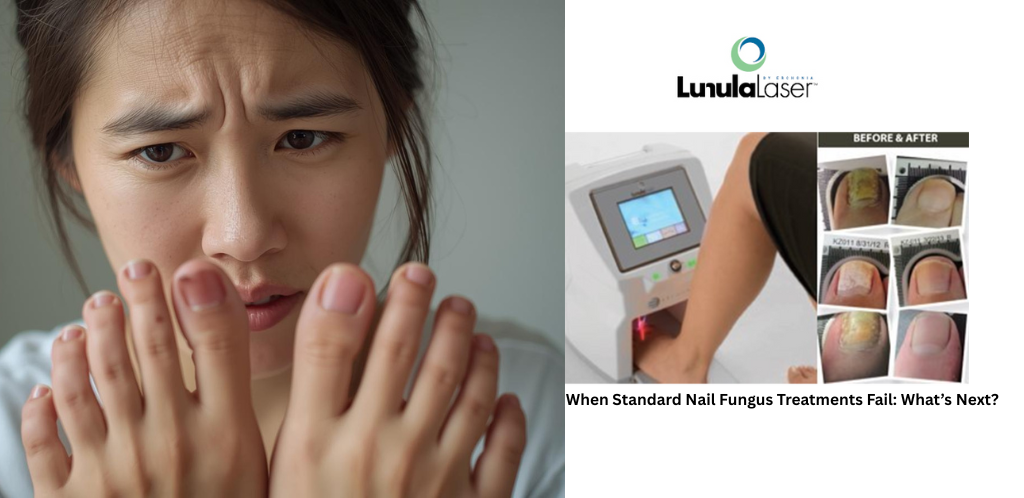
Why lacquers, creams and oral antifungals leave so many patients disappointed, and how clinics are rebuilding confidence in fungal nail care.
By the time a patient raises a fungal nail infection in your chair, it is rarely their first attempt at fixing it. Most have already spent months — often years — and a good deal of money on pharmacy lacquers, home remedies and prescriptions, with results that either never arrived or faded the moment the product stopped.
Ask podiatrists what frustrates them most about onychomycosis and the answer is consistent: they want something that genuinely works, holds up over time, and that they feel comfortable recommending.
The scale of the problem
10–23%
estimated global prevalence of fungal nail infection
~50%
prevalence in adults over 70
23%
projected share of Australians over 65 by 2066
Australia's population is ageing quickly. Adults over 65 made up 8.3% of the population in 1970 and more than 16% by 2020, with projections nearing a quarter of the country by 2066. A large share of that group has a fungal nail infection, and many of them physically cannot reach their feet to paint on a lacquer every day. That combination points squarely at hands-free, low-effort treatment.
At the same time, patients now choose a clinic deliberately rather than defaulting to the nearest one. Treatments offered, reviews and reputation all factor in — so a credible, evidence-backed point of difference matters more than it used to.
Where standard options fall short
Lacquers and topical creams
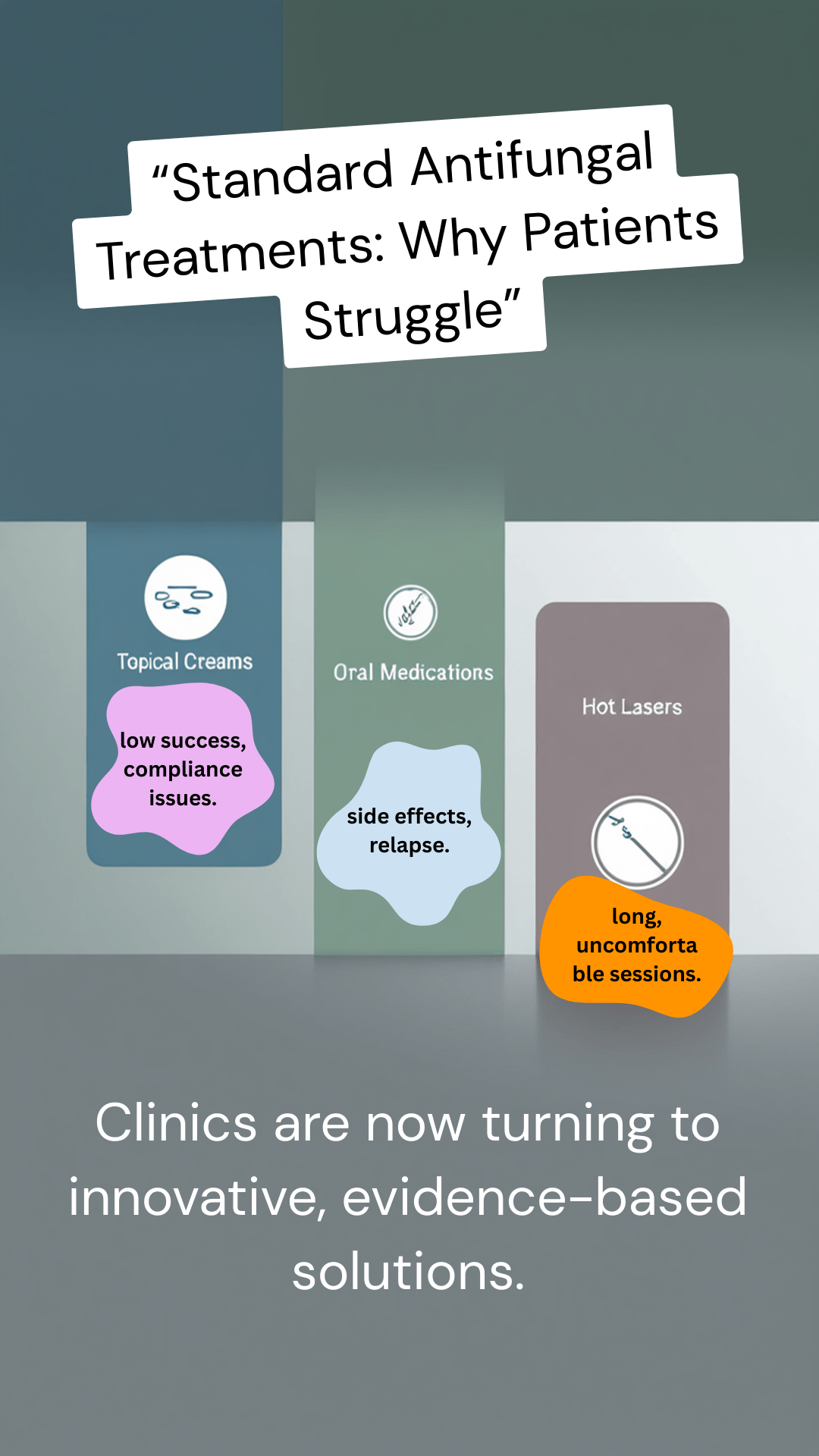
- Fungus sits within and beneath the nail plate, not just on top; topical concentration drops dramatically as it moves inward.
- Reported success rates sit roughly between 5.5% and 17.8%, improving with regular debridement but at real cost in time and appointments.
- Daily application for nine to twelve months is a heavy compliance ask, especially for patients with limited mobility.
- Repeated antifungal exposure raises well-documented resistance concerns.
Oral antifungals
- Mycological cure rates look strong on paper, but complete cure rates in the same studies land far lower.
- Relapse within months of finishing a course is common.
- Interactions and hepatic risk rule out a meaningful slice of the podiatric caseload.
- Measured adherence over a full course is often barely above half.
Where clinics are going instead
Practices that have moved past the standard toolkit tend to do three things: set patient expectations properly at the first consult, package a full course of treatment rather than selling single sessions, and choose a modality that does not depend on the patient doing the work at home.
That is the gap the Lunula low-level laser is built for — a hands-free, non-thermal, 12-minute session that the patient simply sits through, with clear nail growth as the measured endpoint and no consumables to reorder.
Setting expectations that actually hold
Clear nail growth is the honest endpoint to promise, and it is slow: a toenail replaces itself over roughly nine to twelve months, so a patient reviewed at three months should be looking for healthy nail emerging from the matrix rather than a cosmetically perfect nail. Photographing the nail at baseline and at each review is the single cheapest thing a clinic can do to keep patients engaged, because progress that is obvious in a side-by-side photo is invisible day to day.
It also pays to separate cure from clearance in the conversation. Mycological cure means the organism is no longer detectable; clinical clearance means the nail looks normal again. Published series frequently report the first without the second, which is exactly the mismatch that makes patients feel their previous treatment 'did nothing'.
Why reinfection is the part everyone skips
- Footwear is a reservoir — recommend rotating shoes, drying them fully, and using an antifungal shoe spray or UV shoe steriliser during and after the treatment course.
- Treat concurrent tinea pedis; untreated skin infection reseeds the nail.
- Check household contacts and shared bathroom surfaces, particularly in family homes and aged-care settings.
- Sterilise or replace nail files and clippers, and debride with single-use burrs where practical.
- Review at six and twelve months rather than discharging at the end of the treatment course.
Who needs a different plan
Patients with diabetes, peripheral vascular disease, immunosuppression or a history of cellulitis warrant a lower threshold for intervention, because an untreated dystrophic nail is a portal of entry rather than a cosmetic issue. Equally, patients on warfarin or oral hypoglycaemics, or with hepatic impairment, are the group for whom oral antifungals are least attractive — and where a non-systemic in-clinic option carries the clearest advantage.
References & further reading
- 1.Abrahams C. Lasers and onychomycosis — Podiatry Management, October 2019 (PDF)
- 2.Zang K et al. A retrospective study of non-thermal laser therapy for the treatment of toenail onychomycosis — J Clin Aesthet Dermatol, 2017 (PMC5479474)
- 3.Zang K. Treatment of toenail onychomycosis using laser pharmacology — Int J Dermatol Clin Res, 2021
- 4.Erchonia Lunula — toenail onychomycosis clinical study results report (FDA submission, DOCX)
- 5.Sullivan R. Erchonia laser therapy in the treatment of onychomycosis: preliminary report — Podiatry Review, Vol 71(2), 2014 (PDF)
Considering the Lunula for your clinic?
We can walk you through the protocol, the evidence and the numbers for your practice.
Talk to usMore articles
Competitive research
Top nail fungus innovations: which one earns a place in your clinic?
Clinic business
Lunula laser ROI: is it worth the investment for your clinic?
Clinic business
Unsure if Lunula is right for you? Trial it with us
Innovation
What is the most effective treatment for fungal nail infections?
Innovation
Onychomycosis: past, present and future with Glynis Ablon, MD, FAAD
Clinic business
Your Lunula laser marketing strategy: filling the appointment book